SDG Summer Course on Halal Science and Innovation
for Sustainable Global Food Systems
at Universitas Diponegoro (UNDIP), Semarang
18th May, 20th –21st May, 1st – 5th June 2026
Indonesia is among the majority-Muslim countries, and its citizens form the largest Muslim communities in Southeast Asia. As Muslims, they are required to consume HALALAN/TOYYIBAN products, especially foods, because food is a very basic need of human beings. Practicing HALALAN/TOYYIBAN by Islamic regulation maintains their obedience to the directive of the religion.
By definition, HALALAN means the sources are coming from clean sources (especially animal-originated sources), while TOYYIBAN means ensuring that the consumption won’t affect their well-being.
Tourism is a major contribution to Indonesia’s economy. Indonesians promote their local products (called Oleh-Oleh Khas, especially foods) as items for tourist to bring back to their countries. These products retain their uniqueness by their respective region. For example, Bandeng Presto (milkfish cooked in a special method until its bone becomes soft and consumable) is among Oleh-Oleh Khas from Semarang. By applying the HALAL certification, tourists, especially from Muslim countries, will benefit from it.
New halal logo approved by the Government of Indonesia (2023)
Other than food, HALALAN/TOYYIBAN is also required in other fields like pharmaceuticals, cosmetics, and other lifestyles. Thus, ongoing research regarding the process and certification approved/recognized by the government is a continuous effort that should be welcomed.
Halal Research Institute of Universitas Diponegoro (UNDIP) has organized this Summer Course and invites participants from other universities to join this program to gain knowledge in HALAL processing scientifically. This program is also in line with a few SDGs to ensure sustainability for future generations.
This program comprises online and physical sessions.
For online sessions, it consists of lecture programs which have been divided into 3 days of lectures:
|
Day |
Presenter |
Topics/Key Points |
|
1 (18th May) |
Prof Diana Nur Afifah |
The Role Of Biotechnology In Halal Food Production |
|
Prof Irwandi Jaswir |
Global Halal Industry: Opportunities and Challenges Different Islamic countries have different methods of Halal Certification, which affects the import/export procedure. |
|
|
2 (20th May) |
Prof Widayat |
Critical and Non-critical Points of Materials Used for the Halal Product Process |
|
Prof Satomi Ohgata |
Halal Practices in Japan: Between Strict Halal Standards and Lived Practice in Minority Settings |
|
|
3 (21st May) |
Prof M Ajmal Shah |
Green Extraction Technologies in Halal Phytochemicals (SDG3, SDG9, SDG12, SDG17) |
All participants were also required to submit their assignments on selected topics to ensure a deep understanding of the lectures.
For physical sessions, it comprises visits to selected food manufacturing premises and is explained chronologically as follows:
Day 1 (1st June) – Arrival Day. As I travelled from Malaysia to attend this event, I was picked up at Semarang Airport by UNDIP representative (Mr Aldo Siregar and Miss Syaidah Nabilah), treated with Nasi Padang for lunch, and later checked in at Horizon Antawirya Hotel, near UNDIP campus. Participants also arrived from nearby universities like Universitas Negeri Semarang (UNES) and Universitas Negeri Malang (UM) with different nationalities, mostly from Pakistan, Egypt, and India.
|
|
Day 2 (2nd June)
Visit 1 – Bandeng Juwana Elrina
|
|
Visit 2 – Tahu Bakso Baginda
|
|
Day 3 (3rd June)
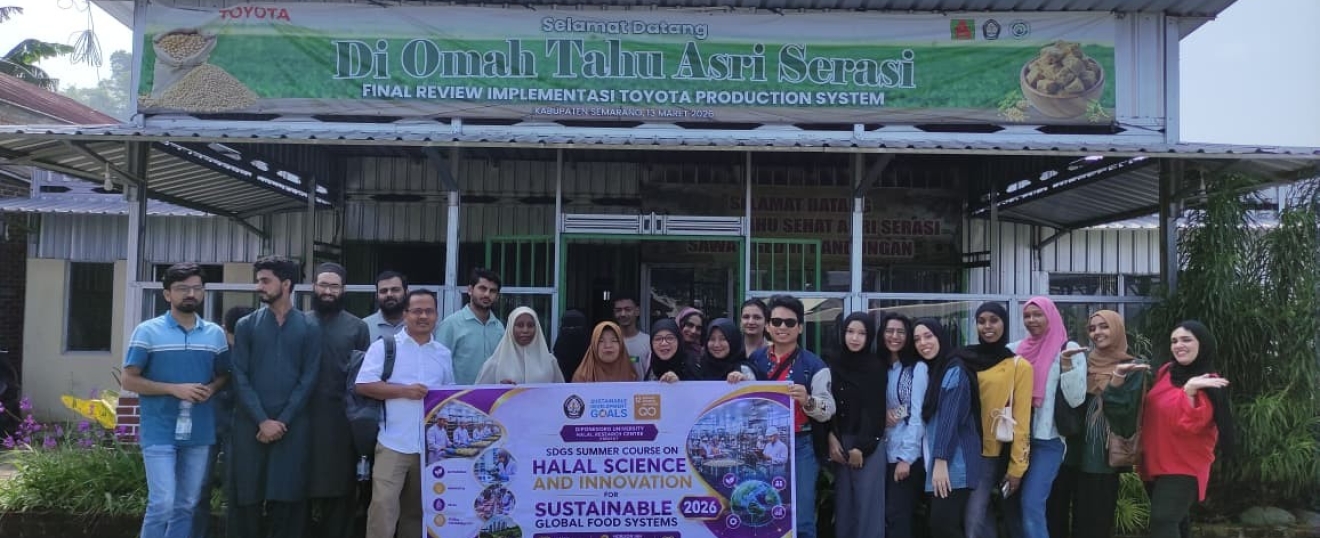
Visit 3 – Tahu Sihat Serasi
|
|
Visit 4 – Kodaro Bakery
|
|
Visit 5 – Lumpia Mataram KP Baris
|
|
Day 4 (4th June)
Group Presentation and Award Ceremony
|
|
|
|
|
|
Day 5 (5th June)
Networking and departure.
|
|
A. CONCLUSION AND APPRECIATION
This program contributes quite abundant knowledge to participants with different cultures and backgrounds, but sharing the same belief in HALALAN/TOYYIBAN. Hopefully, the same concept of the program will continue to be organized in the future.
Congratulations to Halal Research Institute of UNDIP, especially Prof Dr Aries Susanty and its committee members, for organizing this event. Thank you to the Faculty of Industrial Management, Universiti Malaysia Pahang Al-Sultan Abdullah, for allowing me to attend this mobility program.
Reported by:
Suhaimi bin Mat Hussain (KBB23002)
Faculty of Industrial Management
Universiti Malaysia Pahang Al-Sultan Abdullah.