From Classroom to Career Growth – My MPM Journey

From Classroom to Career Growth – My MPM Journey

By: Nur Arissa Asfiera binti Shamsul Fadhli

MPM Alumni 2025 | Quality Engineer (QA/QC) at Syntax Valley Sdn Bhd | PhD student of Graduate Engineering & Technological Business School, Faculty of Industrial Management, UMPSA

Pursuing the Master of Project Management (MPM) at the Graduate Business School has been one of the most transformative experiences of my academic and professional life. Coming from a background in project management, I wanted to deepen my expertise, enhance my leadership skills, and equip myself with the tools needed to navigate complex, real-world challenges. 

The MPM program delivered exactly that, and more. The curriculum was thoughtfully designed, blending theoretical frameworks with practical applications.

PMBOK® Guide - 6th Edition: Understand the Changes

I particularly valued the case studies and group projects, which simulated real project environments and encouraged collaborative problem-solving. These experiences not only sharpened my technical skills but also improved my ability to manage diverse teams and stakeholders effectively. 

What stood out most was the commitment of the faculty. Their industry knowledge, mentorship, and willingness to share personal experiences made the learning environment truly dynamic. Every lecture was an opportunity to bridge the gap between academic concepts and current industry trends. 

Balancing work and studies was challenging, but the flexible learning modes and strong support system from both the faculty and my peers made it achievable. The diverse backgrounds of my classmates enriched discussions and provided new perspectives, broadening my understanding of global project management practices. 

Since completing the program, I have noticed a significant improvement in my confidence, decision-making abilities, and strategic thinking. The skills I developed, particularly in risk management, stakeholder engagement, and project evaluation, have been instrumental in my professional growth. 

The MPM is more than just a degree; it is a transformative journey that equips you with the mindset and competencies to lead with impact. I am proud to be part of the GET-BS community, and I am currently pursuing my PhD to continue advancing my knowledge and expertise in this field.

I would highly recommend this program to anyone looking to elevate their career in project management.


An Interview with Che Nurul Khairunnisa Che Kadir, Managing Director of QC Group Sdn Bhd (HOME Maths Therapy)

An Interview with Che Nurul Khairunnisa Che Kadir, Managing Director of QC Group Sdn Bhd (HOME Maths Therapy)

By: Dr Nurul Ashykin Abd Aziz, Associate Professor Dr Muhammad Ashraf Fauri@Fauzi, Dr Rusnifaezah Musa, Dr Ahmad Huzaimi Abd Jamil

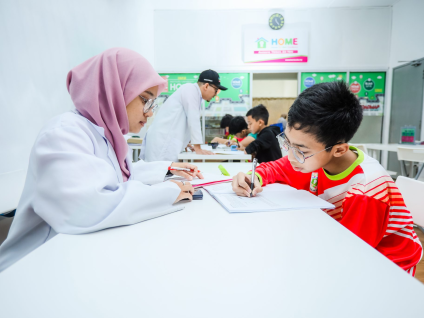
Che Nurul Khairunnisa Che Kadir is the Managing Director of QC Group Sdn Bhd, the company that leads the HOME Maths Therapy brand. Her entrepreneurial journey, marked by resilience and determination, was profoundly shaped by navigating personal challenges, including the severe medical condition of her first child in 2008, and the uncertainty of establishing a business between 2008 and 2012, which she described as a period focused entirely on "survival". This realization, coupled with the discovery that her child had special learning needs in 2011, which included developmental delays in areas like walking and speech, inspired her to establish HOME Maths Therapy. 

Q1: HOME Maths Therapy transitioned from being a program based on one-off workshops to establishing an ongoing service model. What drove the decision to move toward providing continuous support and services?

Although we continued to organize mathematics workshops and seminars since 2010 due to high demand, we began to face challenges because these were one-off events. Since participants could only attend once without continuity, it made sustaining a consistent customer base difficult. This realization highlighted the need for a more creative and sustainable business model to attract long-term customers. In response, we decided to establish HOME Maths Therapy to provide ongoing support and services.


Q2: You described the years between 2008 and 2012 as a period focused entirely on "survival." Can you elaborate on the core challenges you and Sifu Taj were navigating during that time?

The years between 2008 and 2012 were a time of immense struggle for us—a period that was entirely focused on survival. We were navigating the uncertainties of a new market, trying to find our footing as entrepreneurs. At the same time, my husband had just started a new job, and I was in the process of restarting my business, which was still in its infancy. On top of the business challenges, we had just stepped into the role of parenthood, with everything feeling new and overwhelming.


Q3: Your personal journey regarding your eldest child’s health and development was highly influential in the creation of HOME Maths Therapy. What were the specific concerns that led you to believe mathematics could be a solution for special learning needs?

In 2011, the doctor informed us that our eldest child might experience developmental delays; for instance, walking was slow, recognizing types of food was delayed, and speech development was behind, with no first words spoken at the typical age for other children. We began thinking about how we could address these challenges, and we were confident that mathematics could be one of the solutions. We believed it could help develop our child's sensory and cognitive abilities by stimulating brain cell activity. This confidence led us to research the condition and look for other children who faced similar challenges, exploring methods and approaches even beyond our borders.


Q4: Following the profound challenges you faced, how did these experiences directly influence and inspire the founding of HOME Maths Therapy?

The profound challenges we faced became a defining aspect of our journey. These experiences inspired me to establish HOME Maths Therapy, a program designed to transform how students approach and engage with mathematics. Our perspective was profoundly shaped by the realization that our child had special learning needs, which opened our eyes to the importance of a more empathetic and focused approach to teaching, particularly for children who require additional support in their learning journey.


Q5: Your husband, Sifu Taj, spent nearly seven years developing the foundational Bijak Sifir Module. What was your specific role in the evaluation and refinement of this critical educational module?

My role was crucial in assisting Sifu Taj throughout the development of the module. My main responsibility was assisting in evaluating whether the module was truly comprehensive and effective, ensuring it met the needs of students and achieved the intended educational outcomes. Sifu Taj noted that for seven years, he kept presenting his ideas, and I kept rejecting them until 2010 when everything became more structured, and I finally agreed that it was ready to be developed into the Basic Module of Smart Sifir.


Q6: You identified that mathematics poses a significant challenge for many Malaysian students due to varying levels of thinking. How did this recognition shape the core therapeutic approach of HOME Maths Therapy?

We recognized that mathematics poses a significant challenge for many students in Malaysia, which is a concern shared by parents, educators, and schools. Knowing that every student possesses a different level of thinking, with some grasping mathematics quickly while others are slower learners, we emphasized the importance of therapy and innovative learning methods. We believed these approaches were crucial in helping children with diverse learning needs to better understand and engage with mathematics, providing a holistic solution for children to master the subject with confidence and ease.


Q7: From a philosophical perspective, how do you view the franchise concept of HOME Maths Therapy, beyond just being a successful business venture?

Over the 12 years of HOME Maths Therapy's journey, the business has been developed with a franchise concept grounded in the awareness of fardhu kifayah. From the perspective of mathematics education and the mission of business jihad, we also view this endeavor as an act of worship.

* Want to explore the full story of HOME Maths Therapy?

Get your copy now from UMPSA Publisher Bookstore or conveniently on Shopee:  https://my.shp.ee/uWRDUxK


Q & A with Dato Kamarul A Muhamed, Aerodyne’s Group CEO and Founder

Q & A with Dato Kamarul A Muhamed, Aerodyne’s Group CEO and Founder

By: Associate Professor Dr Puteri Fadzline Muhamad Tamyez, Associate Professor Dr Cheng Jack Kie, Dr Nurul Ashykin Abd Aziz, Dr Khairunnisa Abd Aziz

Dato Dr Kamarul A Muhamed, Aerodyne’s Group CEO and Founder, transformed the initial media production startup, launched from a modest 1,200-square-foot office, into a Digital Transformation as a Service (DT3) powerhouse. Known for strategic foresight and commitment to building deep tech and AI teams, Kamarul’s tenure focuses on navigating hyperscaling and leveraging technology while upholding Aerodyne’s core values of vision and relentless adaptability.

Q1: What was the spark that launched Aerodyne?

The spark that launched Aerodyne was a pivotal realization that shifted the company’s focus from mere visual capture, such as filming documentaries, which was deemed “not scalable,” to prioritizing data intelligence and digital transformation. This core turning point involved recognizing that the real value wasn’t in the drones themselves, but in the data, we collected and the insights we could provide, thereby positioning Aerodyne to deliver digital transformation as a service (DXaaS). This entrepreneurial vision, rooted in the understanding that "Drones are really IoT devices" capable of solving problems for industries with large, geographically dispersed assets, found its genesis during the founder's master's degree studies in digital transformation. Furthermore, the initial frustration caused by the limitations of the DragonFlyer X6 drone served as a catalyst, prompting the fundamental question: What if this technology could be better? What if drones could evolve into something more reliable, versatile, and impactful?

Q2: What’s been your biggest challenge as a founder?

The biggest challenge I face as a founder encompasses both internal friction and external existential threats: internally, successful scaling demands that I embrace ‘Founder Mode’ to resist conventional management advice and bureaucracy, managing complexities like cultural alignment, talent acquisition, and critically, avoiding the leading cause of Malaysian startup failure, identified as disputes among partners. Externally, survival depends on mastering energy management, maintaining financial prudence during periods like a ‘funding winter’, navigating ‘complex and often restrictive’ regulatory environments, and avoiding the fatal mistake Paul Graham describes as shrinking from contact with the real world or contact with your users and instead building something that users don’t like. 

Q3: How do you stay innovative in such a fast-moving industry?

We maintain innovation by strategically focusing on being a Digital-Transformation-as-a-Service (DXaaS) provider, pivoting from mere visual data capture to prioritizing the data we collected and the insights we could provide. This technological leadership we achieved was through the continuous development of proprietary deep tech and AI solutions, such as the DRONOS 3D digital twin platform and specialized models achieving up to 98.8% precision in industrial inspections. Operationally, we emphasize adaptability and continuous adoption, learning, recognizing that technology shifts rapidly, ensuring we constantly seek scalable solutions to complex industrial problems and align their innovations with national priorities like energy security and Industry 4.0.

Q4: What does the world not yet fully recognize Aerodyne as?

The world's current perception of Aerodyne significantly lags behind our true identity and profound transformation, often comparing us to the drone services companies we have long surpassed. While the external view recognized the company as the world’s largest drone solutions provider by 2021, we have since undergone a complete reinvention from a mere service provider into a data-driven deep tech company focusing on building platforms that could ‘power nations. Aerodyne is now a sovereign-grade digital infrastructure partner that constructs intelligent, AI-powered operating systems for critical sectors like agriculture, energy, logistics, and security. 

Now, in every sense, resemble us as the “Palantir of Drones”, utilizing proprietary platforms like DRONOS, AGRIMOR, ARGENTAVIS, FULCRUM, and ALPHA GEOINT—the digital nervous systems of tomorrow’s infrastructure—to transform the physical world into manageable, intelligent systems. While we remain profitable at the project level, the leadership views the future they are investing in as far more exciting, far more promising, and far more scalable than any legacy project model". We are now committed to realigning its narrative to communicate its deep-tech status and its objective of building technology that transforms nations and competes with the world’s best on the global stage.

*The Q & A with Dato Dr Kamarul A Muhamed was based on GET-BS's CEO Talk in 2024 -https://www.youtube.com/watch?v=9JOFXTysT10


FIM UMPSA Sets New Record in Global Rankings

FIM UMPSA Sets New Record in Global Rankings

By: Professor Dr Yudi Fernando

Academic Associates of Graduate Engineering & Technological Business School | Professor of the Faculty of Industrial Management, UMPSA

Universiti Malaysia Pahang Al-Sultan Abdullah (UMPSA) made history by securing a place in the 251-300 category globally for its Business and Economics subjects, according to The Times Higher Education World University Rankings in 2025. 

This achievement underscores UMPSA's high academic standards, research quality, productivity, and standing in the field compared to other global institutions. In 2025, approximately 990 universities from 85 countries and territories have participated to be assessed based on 18 rigorous performance indicators. These assessments are meticulously conducted to showcase and highlight the unique attributes within the field of business and economics. 

This remarkable accomplishment is a source of immense pride for all involved stakeholders at this relatively young technical university. Beyond just a ranking, this achievement positions UMPSA as the Malaysian Technical University Network (MTUN), distinguished by its distinctive expertise in integrating technical aspects into teaching, research, consultations, and collaborations with industry and governmental bodies. Under this ranking system, each university demonstrates strengths in research quality, international outlook, research environment, industry connections, and teaching capabilities. 

In assessing and positioning university subject rankings in Business and Economics, UMPSA has competed with other world-renowned top universities. The first to fifth subject rankings were awarded to each university, such as Massachusetts Institute of Technology (MIT), Stanford University, University of Oxford, Peking University and University of Cambridge. In Malaysia, UMPSA shares the same position as Sunway University, with an overall total score of 41.5-43.9. Higher ranks in Business and Economics subjects are still dominated by established research universities such as Universiti Malaya, Universiti Putra Malaysia, Universiti Sains Malaysia, Universiti Teknologi Malaysia and management-focused universities like Universiti Utara Malaysia. 

If it looks more closely, Business and Economics subjects are assessed based on three core subject areas: Business and Management, Accounting and Finance, & Economics and Econometrics. These subjects are offered at the Faculty of Industrial Management (FIM) and indicate that FIM has good capabilities in managing faculties based on the five core pillars of evaluation. The first pillar is Teaching. This category is assessed based on the reputation of faculty and lecturers in teaching, including the lecturer's experience in the industry before becoming an academic. Apart from that, it is also calculated based on student-to-staff ratio, doctorate-to-bachelor ratio, and institutional income. 

The Faculty of Industrial Management (FIM) at UMPSA offers four unique undergraduate programs designed to enrich the Technical and Vocational Education and Training (TVET) ecosystem in Malaysia. These programs include the Bachelor of Industrial Technology Management with Honours, Bachelor of Project Management with Honours, Bachelor of Business Engineering with Honours, and Bachelor of Business Analytics with Honours. Almost all of these programs have been accredited by international accreditation bodies such as ABEST21 (Japan) for MBA, CILT (UK) for Bachelor of Business Engineering with Honours, GAC (PMI) for Bachelor of Project Management with Honours, and IOA for Bachelor of Business Analytics with Honours.

The second pillar is the research environment. FIM UMPSA enjoys a strong research reputation, both in terms of output and scholars' reputations. The faculty has a track record of publishing quality papers in top journals recognized by the Association of Business Schools UK (ABS), the Australian Business Deans Council (ABDC), and the French journal ranking system FNEGE, among others. Additionally, FIM UMPSA lecturers have secured numerous international, national, and industry research grants, demonstrating their research capabilities.

The third pillar is research quality. Several FIM UMPSA lecturers have made significant contributions to their fields, as evidenced by their citation impact, strength, and influence. This research quality is supported by six focused research clusters: (1) Operations and Supply Chain Management, (2) Ethics, Governance, and Organization, (3) Project Management, (4) Marketing and Entrepreneurship, (5) Finance, Accounting, and Economics, and (6) Business Analytics and Modelling.

The fourth pillar is industry partnerships and intellectual property. Many FIM lecturers hold strategic positions in professional agencies and industry associations, fostering strong industry connections. The faculty also places a strong emphasis on intellectual property, including patents and copyrights. 

Lastly, FIM UMPSA has an international outlook. The faculty has successfully attracted international students to its postgraduate programs, including participation in global student mobility programs. FIM UMPSA also welcomes global lecturers who aspire to join as full-time faculty based on their competencies. Co-authorship in research projects further strengthens FIM UMPSA's internationalization efforts.

Currently, FIM UMPSA is actively preparing to develop a graduate engineering and technology business school (GET-BS), as well as various competitive postgraduate programs tailored to meet industry needs, all based on a high-level TVET framework. To obtain more information, FIM UMPSA stakeholders can visit the official website using the following link: https://fim.umpsa.edu.my/.