My International Mobility Experience at UNDIP 🇮🇩

My International Mobility Experience at UNDIP 🇮🇩

SDG Summer Course on Halal Science and Innovation

for Sustainable Global Food Systems

at Universitas Diponegoro (UNDIP), Semarang

18th May, 20th –21st May, 1st – 5th June 2026


Indonesia is among the majority-Muslim countries, and its citizens form the largest Muslim communities in Southeast Asia. As Muslims, they are required to consume HALALAN/TOYYIBAN products, especially foods, because food is a very basic need of human beings. Practicing HALALAN/TOYYIBAN by Islamic regulation maintains their obedience to the directive of the religion.

By definition, HALALAN means the sources are coming from clean sources (especially animal-originated sources), while TOYYIBAN means ensuring that the consumption won’t affect their well-being.

Tourism is a major contribution to Indonesia’s economy. Indonesians promote their local products (called Oleh-Oleh Khas, especially foods) as items for tourist to bring back to their countries. These products retain their uniqueness by their respective region. For example, Bandeng Presto (milkfish cooked in a special method until its bone becomes soft and consumable) is among Oleh-Oleh Khas from Semarang. By applying the HALAL certification, tourists, especially from Muslim countries, will benefit from it.

New halal logo approved by the Government of Indonesia (2023)

Other than food, HALALAN/TOYYIBAN is also required in other fields like pharmaceuticals, cosmetics, and other lifestyles. Thus, ongoing research regarding the process and certification approved/recognized by the government is a continuous effort that should be welcomed.  


Halal Research Institute of Universitas Diponegoro (UNDIP) has organized this Summer Course and invites participants from other universities to join this program to gain knowledge in HALAL processing scientifically. This program is also in line with a few SDGs to ensure sustainability for future generations.

This program comprises online and physical sessions.

My International Mobility Experience at UNDIP 🇮🇩

My International Mobility Experience at UNDIP 🇮🇩

SDG Summer Course on Halal Science and Innovation

for Sustainable Global Food Systems

at Universitas Diponegoro (UNDIP), Semarang

18th May, 20th –21st May, 1st – 5th June 2026


Indonesia is among the majority-Muslim countries, and its citizens form the largest Muslim communities in Southeast Asia. As Muslims, they are required to consume HALALAN/TOYYIBAN products, especially foods, because food is a very basic need of human beings. Practicing HALALAN/TOYYIBAN by Islamic regulation maintains their obedience to the directive of the religion.

By definition, HALALAN means the sources are coming from clean sources (especially animal-originated sources), while TOYYIBAN means ensuring that the consumption won’t affect their well-being.

Tourism is a major contribution to Indonesia’s economy. Indonesians promote their local products (called Oleh-Oleh Khas, especially foods) as items for tourist to bring back to their countries. These products retain their uniqueness by their respective region. For example, Bandeng Presto (milkfish cooked in a special method until its bone becomes soft and consumable) is among Oleh-Oleh Khas from Semarang. By applying the HALAL certification, tourists, especially from Muslim countries, will benefit from it.

New halal logo approved by the Government of Indonesia (2023)

Other than food, HALALAN/TOYYIBAN is also required in other fields like pharmaceuticals, cosmetics, and other lifestyles. Thus, ongoing research regarding the process and certification approved/recognized by the government is a continuous effort that should be welcomed.  


Halal Research Institute of Universitas Diponegoro (UNDIP) has organized this Summer Course and invites participants from other universities to join this program to gain knowledge in HALAL processing scientifically. This program is also in line with a few SDGs to ensure sustainability for future generations.

This program comprises online and physical sessions.

For online sessions, it consists of lecture programs which have been divided into 3 days of lectures:

Day

Presenter

Topics/Key Points

1 (18th May)

Prof Diana Nur Afifah

The Role Of Biotechnology

In Halal Food Production

Prof Irwandi Jaswir

Global Halal Industry: Opportunities and Challenges

Different Islamic countries have different methods of Halal Certification, which affects the import/export procedure.

2 (20th May)

Prof Widayat

Critical and Non-critical Points of Materials Used for the Halal Product Process

Prof Satomi Ohgata

Halal Practices in Japan: Between Strict Halal Standards and Lived Practice in Minority Settings

3 (21st May)

Prof M Ajmal Shah

Green Extraction Technologies in Halal Phytochemicals (SDG3, SDG9, SDG12, SDG17)


All participants were also required to submit their assignments on selected topics to ensure a deep understanding of the lectures.

For physical sessions, it comprises visits to selected food manufacturing premises and is explained chronologically as follows:

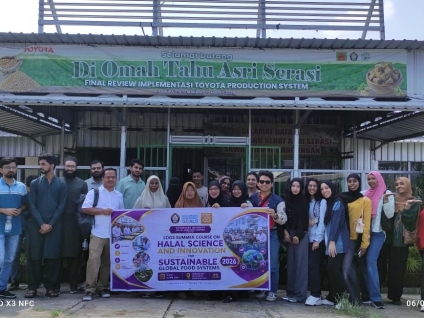
Day 1 (1st June) – Arrival Day. As I travelled from Malaysia to attend this event, I was picked up at Semarang Airport by UNDIP representative (Mr Aldo Siregar and Miss Syaidah Nabilah), treated with Nasi Padang for lunch, and later checked in at Horizon Antawirya Hotel, near UNDIP campus. Participants also arrived from nearby universities like Universitas Negeri Semarang (UNES) and Universitas Negeri Malang (UM) with different nationalities, mostly from Pakistan, Egypt, and India.


Day 2 (2nd June)

Visit 1 – Bandeng Juwana Elrina


Visit 2 – Tahu Bakso Baginda


Day 3 (3rd June)

Visit 3 – Tahu Sihat Serasi


Visit 4 – Kodaro Bakery


Visit 5 – Lumpia Mataram KP Baris


Day 4 (4th June)

Group Presentation and Award Ceremony


Day 5  (5th June) 

Networking and departure.


A.  CONCLUSION AND APPRECIATION


This program contributes quite abundant knowledge to participants with different cultures and backgrounds, but sharing the same belief in HALALAN/TOYYIBAN. Hopefully, the same concept of the program will continue to be organized in the future.


Congratulations to Halal Research Institute of UNDIP, especially Prof Dr Aries Susanty and its committee members, for organizing this event. Thank you to the Faculty of Industrial Management, Universiti Malaysia Pahang Al-Sultan Abdullah, for allowing me to attend this mobility program.


Reported by:

Suhaimi bin Mat Hussain (KBB23002)

Faculty of Industrial Management

Universiti Malaysia Pahang Al-Sultan Abdullah.



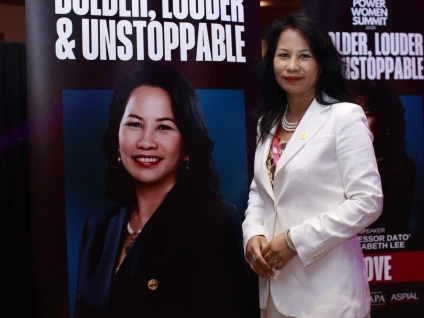
Q & A with Aida Ismail, Regional Director for Asia, HADID International Services (UAE)

Q & A with Aida Ismail, Regional Director for Asia, HADID International Services (UAE)

From Runway to Boardroom: The Strategic Decision-Making Playbook Behind Aviation’s Wins


Q1: How did the emotional trauma of past tragedies personally shape the mindset of MAS executives during the 2024 and 2026 conflicts?

For MAS executives, the 2014 downing of MH17 was a tragic watershed moment that deeply affected the company's culture. This profound loss means that today, boardroom decisions are not just about algorithms; they are driven by an uncompromising, permanent "zero-risk" mindset. When new drones or missiles launch, leaders do not hesitate—they immediately execute detours to protect lives, prioritizing absolute safety to prevent history from repeating itself.

Q2: If you were a stranded passenger in the Middle East during the Q1 2026 airspace closures, how would MAS's strategic decisions have personally affected you?

You would have likely felt a massive sense of relief. While Gulf carriers—which normally handle 40% of all Asia-Europe connecting traffic—were forced into massive network cancellations, leaving passengers stranded in paralyzed mega-hubs, MAS came to the rescue. By mobilizing three extra A350-900 relief flights, MAS provided over 900 immediate seats to safely bring stranded travelers home through Kuala Lumpur.

Q3: What was the most difficult ‘courageous’ decision an airline CEO had to make in April 2024 regarding KUL-London flights?

The most difficult decision was intentionally losing money to guarantee safety. Because the rerouted flights took over 13.5 hours, the planes needed maximum fuel, which meant there was no weight allowance left for lucrative cargo. The CEO and boardroom had to make the tough call to completely freeze all cargo freight for two weeks. It takes strong leadership to accept a massive short-term revenue loss as the ultimate defense of passenger lives and brand equity.

Q4: Why would the C-suite executives of an airline feel intense ‘financial pain’ and stress even when their planes were successfully flying around the conflict zones?

The stress comes from watching their profit margins completely vaporize overnight. The sudden spike in jet fuel costs consumed a crushing 35% of total airline overheads. Imagine the immense pressure of running a massive, highly complex airline operation, only to see global average earnings shrink to a razor-thin profit margin of just 2%—or about $4.50 per passenger ticket. This leaves executives with absolutely zero financial room for error.

Q5: As future business leaders, what personal mindset shift should MBA students learn from MAS's belief that ‘Geography is destiny’?

Students should learn to view their perceived limitations as strategic advantages. Traditional Gulf mega-hubs are usually the dominant players, but during geopolitical crises, their location becomes a liability. A strategic leader shifts their mindset to capitalize on this by confidently positioning their own safe, unaffected geography—like Kuala Lumpur—as the ultimate resilient fallback corridor, turning global chaos into a market gain

More insights can be watched on our YouTube: https://www.youtube.com/watch?v=t_iQC_Xk3-k

Q & A with Log. Ts. Dr. Adam Mohd Saifudin, Deputy President of The Society of Logisticians

Q & A with Log. Ts. Dr. Adam Mohd Saifudin, Deputy President of The Society of Logisticians

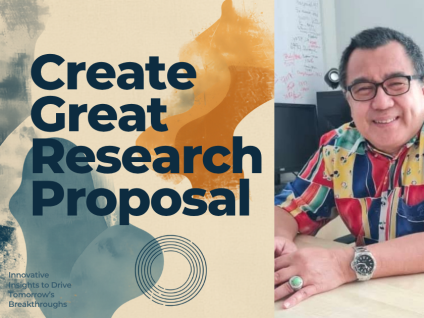
Tips on How to Make a Great Research Proposal: Industry Nexus Research

Q1: What is the fundamental purpose of conducting research, according to Dr. Adam? 

While many academics joke that research is simply for meeting university KPIs, I would like to emphasize that the true, positive motivations for research are to contribute to new knowledge and to support nation-building and industry growth. It is a systematic effort to solve problems and evaluate facts that ultimately benefit society, the industry, and the country.

Q2: From an examiner's perspective, what is the most critical part of a research proposal or thesis that determines its success?

To me, Chapter One is the most crucial element because it dictates the entire story of the thesis. Examiners look closely at the "problem statement" or research gap. If the research problem does not correctly align with the research questions and objectives in Chapter One, the literature review and subsequent data findings will lack a proper foundation, often leading to major corrections or failure.

Q3: What specific financial strategy should researchers use when drafting their proposal budgets?

I would suggest that researchers should request a realistic, prudent budget, but they must always include a 10% to 20% contingency budget. This extra buffer is vital to cover unexpected expenditures during the project or to compensate if the funder (like the government or an industry partner) approves a lower grant amount than initially requested.

Q4: How can university researchers successfully secure research grants from private industries?

To secure industry funds, we as researchers must convince the company by proving they can deliver tangible results that solve real, immediate operational problems (such as warehousing or distribution inefficiencies). Additionally, researchers can incentivize companies by informing them that financial contributions toward university research can be deducted from the company's income tax.

Q5: What are a major pitfall students and researchers face when working on group reports, and how can it be avoided?

A common and severe mistake is "compiling without reading." Group members often divide the sections, write them individually, and staple them together at the last minute without reviewing the overall flow. To avoid a disjointed report, groups must meet frequently, discuss the direction, and ensure that every single member reads and verifies the finalized compiled document.

Q6: What is the Society of Logisticians Malaysia (LogM) and what unique privilege does it grant its professional members?

LogM is a professional NGO designed to foster networking, knowledge sharing, and professional development among logisticians in Malaysia. One of its most unique privileges is that legally qualified members (Fellow LogM and Member LogM) are officially awarded the right to use the prefix "Log." before their names (e.g., Log. Dr. Adam), signaling their professional expertise.

Q7: How does Dr. Adam contrast the mindsets of industry practitioners versus academic staff, and why is collaboration necessary?

I am an industry practitioner, and we have vast daily operational experience but often lack large-scale theoretical planning or visionary frameworks. Conversely, academic university staff possess massive theoretical knowledge ("cognitive value") but usually lack practical, on-the-ground industry experience. Industry-university collaboration is crucial because it merges these two worlds, bridging the knowledge gap to produce practical, high-impact solutions.

View the full video at : https://www.youtube.com/watch?v=yD26UBvgrvQ


Â